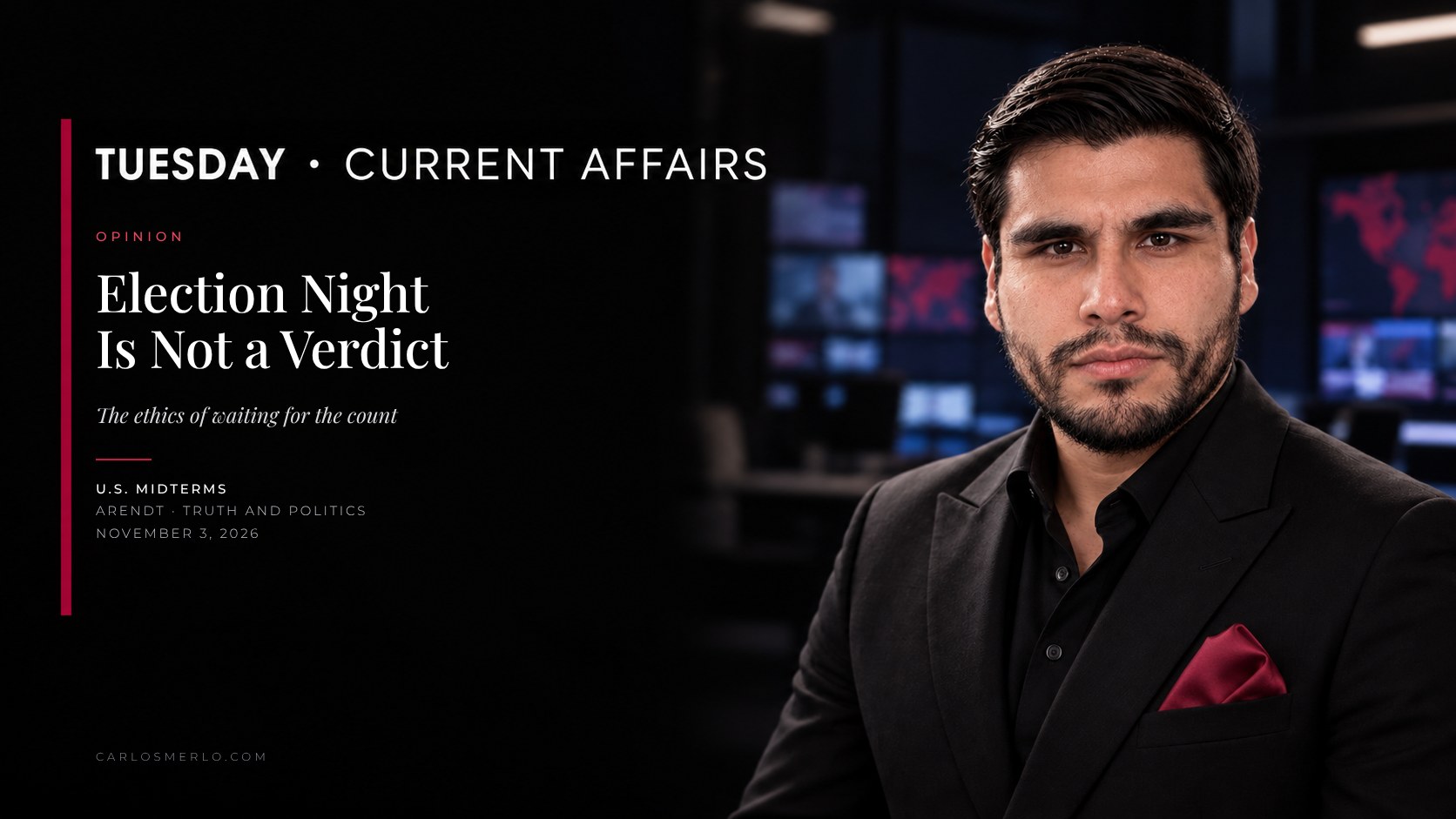
Election Night Is Not a Verdict: The Ethics of Waiting for the Count
Tonight, millions of Americans will watch numbers move on a screen and mistake them for a result. The gap between the first count and the final count is not a flaw in democracy. It is where truth takes time, and where leaders reveal whether they respect it.
Executive summary
- The moment: the United States votes today. Tonight's numbers will be partial, and they will move.
- The problem: audiences, campaigns and some leaders treat the first count as a verdict. When later ballots change the picture, the change itself is presented as evidence of fraud.
- The argument: waiting for the full count is not a technical inconvenience. It is an ethical and epistemic obligation, and the way leaders handle the wait tests their respect for factual truth.
- The lesson: in elections, as in crises, the most dangerous statement is a confident one made before the facts are complete.
A count is a process, not an event
Every election night produces the same illusion. Results appear on screen within minutes of polls closing, maps fill with color, and commentators speak of leads and trends. It feels like the election is being decided in real time.
It is not. What appears on election night is a partial snapshot, shaped by which ballots each jurisdiction counts first. In many places, in-person votes are tallied quickly, while mail-in and provisional ballots take longer to verify and process. The order of counting, not the will of the voters, determines how the early picture looks.
Legal scholar Edward Foley documented this pattern more than a decade ago and called it the "blue shift": in recent U.S. elections, ballots counted later have tended to lean Democratic, so early leads for Republican candidates can narrow or reverse as the count continues (Foley, 2013; Foley & Stewart, 2020). The direction of the shift is a product of how and when different groups vote. It says nothing about the legitimacy of the ballots themselves.
The Brennan Center's pre-election brief for these midterms is blunt on the point: "Election results are never final on election night" (Tisler et al., 2026). Among the false narratives it expects are claims that shifts during the count prove fraud, and premature declarations of victory before results are certified.
Factual truth needs time
Hannah Arendt's essay "Truth and Politics," first published in The New Yorker in 1967, remains one of the clearest guides to this problem. Arendt distinguished between rational truths, such as those of mathematics or philosophy, and factual truths: things that happened, which can only be established by witnesses, records and procedures. Factual truth, she argued, is the more fragile of the two. It has no logical necessity behind it, and it can be denied, rewritten or drowned out by opinion.
An election result is a factual truth in Arendt's sense. It exists only once millions of individual acts have been recorded, verified and added up. Until that procedure is complete, there is no result to report, only an estimate. Treating the estimate as the fact is not a small exaggeration. It replaces a procedure that produces truth with a performance that imitates it.
This is why the period between the first count and the final certification is so vulnerable. It is the moment when factual truth is still being constructed, and when anyone with an audience can try to fix an opinion in place before the facts arrive.
The ethics of the premature claim
From the perspective of communication ethics, three behaviors deserve particular scrutiny tonight.
- Declaring victory early. A candidate who claims to have won before the count is complete is not making a forecast. He or she is trying to create a reference point that later facts will appear to contradict.
- Framing normal changes as anomalies. Describing a predictable shift as "suspicious" or "a sudden reversal" teaches audiences to distrust the process precisely when it is working as designed.
- Amplifying uncertainty for engagement. Media and platforms that reward dramatic updates over accurate context turn a slow, ordinary procedure into a suspense story, and suspense invites conspiracy.
None of these requires a factual lie. Each one exploits the time it takes for facts to become complete. That is what makes them effective, and what makes them ethically corrosive.
What responsible leadership looks like tonight
The lessons apply well beyond the United States and well beyond elections. Any organization that communicates during an unfolding event faces the same temptation to speak with certainty before certainty exists.
- Say what is known, and what is not yet known. "We are ahead with 60 percent of the vote counted" is accurate. "We have won" is not.
- Explain the process before it is questioned. Leaders who describe in advance how and when ballots will be counted make later shifts unsurprising.
- Name the timeline. Audiences tolerate waiting when they know how long it will take.
- Refuse the frame of fraud without evidence. A change in the numbers is not a story about wrongdoing unless there is evidence of wrongdoing.
Closing note
Arendt warned that the deepest damage of systematic falsehood is not that lies come to be believed, but that people lose the sense by which they take their bearings in the real world. Election night is a recurring test of that ability. The numbers will move tonight. That movement is not the system failing; it is the system doing the slow work of establishing what happened. Leaders who respect that work, and who are willing to wait, are defending more than an outcome. They are defending the conditions that make any shared outcome possible.
References
Arendt, H. (1967, February 25). Truth and politics. The New Yorker.
Foley, E. B. (2013). A big blue shift: Measuring an asymmetrically increasing margin of litigation. Journal of Law and Politics, 27.
Foley, E. B., & Stewart, C., III. (2020). Explaining the blue shift in election canvassing (MIT Political Science Department Research Paper Series). SSRN. https://ssrn.com/abstract=3547734
Tisler, D., Harper, T., & Brouard, J. (2026, October 9). Anticipating election misinformation in the 2026 midterms. Brennan Center for Justice. https://www.brennancenter.org/our-work/research-reports/anticipating-election-misinformation-2026-midterms